

Rich nutrition, a robust tradition of medicinal use, and a strong national production underpinned by family farms were the factors that convinced two Ecuadorian friends of chia seeds’ potential for success. From marketing chia and quinoa seeds, Live Kuna has grown into an expert in crafting brands with traceability and sustainability at their core.
Live Kuna is an Ecuador-based company with a product range spanning over several categories, including plantain and quinoa flour, moringa powder, multigrain pastas and superfood sweet and savoury puffed snacks. The offering has evolved immensely from its foundation in 2013, when it sold chia seeds sourced from Ecuadorian family farmers.
Live Kuna is seeing double digit growth month on month and expects to double sales this year in comparison to last.
The superfood company was created by Santiago Stacey and Carlos Gutierrez, two Ecuadorian school friends who discovered that their homeland had many nutritious traditional foods, like chia seeds and quinoa, and saw potential for products with a strong transparency message.
Although the medicinal use of chia in South America stretches back centuries, Stacey got his first taste of the black seeds only after moving to the northern hemisphere. “I discovered chia seeds and started eating them in Canada. Funnily enough, I had never seen them in Ecuador because at that time you wouldn’t find them in supermarkets,” Stacey, co-founder and CEO of Live Kuna, told New Nutrition Business.
He came across chia seeds at a trade show in Toronto and was immediately intrigued. While they had a bland and underwhelming taste, their nutritional profile was impressive, featuring omega-3 fatty acids, protein and fibre.
Stacey dived into research about the product and unearthed a surprising story of the deep ties between chia seed and his motherland. He learned that Ecuador was a major chia seed producer, a fact which had eluded him because the bulk of the produce was being exported, and the rest sold in small town markets. From his grandmother he learned about the traditional use of chia seeds for medicinal purposes, as a source of energy and fibre.
The strong backstory and health benefits convinced Stacey chia seeds had great business potential. He contacted Gutierrez, setting in motion the wheels of what was to become Kuna Chia, a company promoting the health benefits of chia, and which would grow into Live Kuna.
“Kuna means ‘to give’ in Quechua, which is an indigenous language from the Andean region. So it resonates a lot with indigenous cultures and with what the vision of the company of Carlos and myself was, which is to give health to the world through nutritious products, starting with chia. And we grew from there because we were the first ones to do it,” Stacey explained.
Live Kuna took a different angle from other food companies by working directly with farmers in Ecuador and highlighting traceability and transparency in their supply chain.
But as with so many plants, chia seeds and quinoa require some effort from the consumer to get to an edible and palatable product. This compelled Stacey and Gutierrez to figure out how to deliver ancient foods in an easier-to-consume format – and the Kuna Pops snack and cereal range was the result. “We created Kuna Pops because we wanted to give our consumers superfoods like quinoa and chia seeds in a convenient, healthy and delicious format,” Stacey explained.
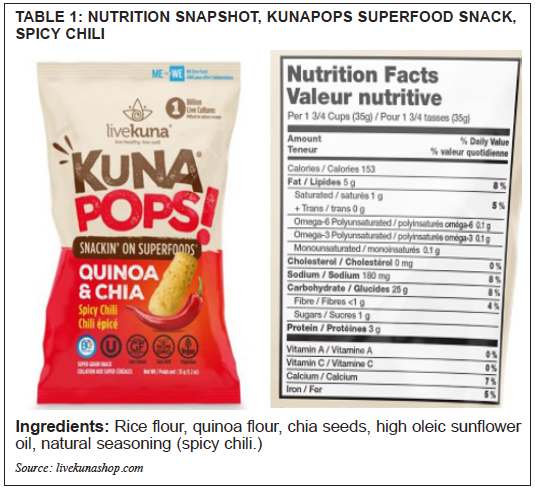
Kuna Pops’ first launch was in Ecuador in 2018, and it landed in the US in the summer of 2021, appearing in 364 Sprouts Farmers Market locations. The snack and cereal range is sold online for $39.99 (€35.20) for a box of ten 100g bags. Free-from gluten and GMO, the flavours include:
- Spicy Chili
- Tomato & Basil
- White Cheddar
- Chocolate
- Banana
- Apple and Cinnamon
Kuna Pops cereal puff range comes in three sweet flavours: chocolate, banana and apple and cinnamon. On the company website, a pack of three 255g boxes sells for $19.99 (€17.60). The range is currently also sold in Panama, Guatemala, Mexico, Canada, and Portugal.
Making the farmers that produce Live Kuna’s raw ingredients the cornerstone of the company’s messaging ties in well with current heightened consumer interest in the provenance and history of the food they eat. “I think that right now we’re at a stage where people want to understand what they consume, they want to learn more about the culture. There’s a belief that in the past we used to be more mindful about what we ate and that we ate less processed, straight-from-the-earth foods,” Stacey explained.
In an effort to give more insight into their production, Live Kuna uses pictures of farmers manufacturing their grains on the product. “We work with a farmer called Marcelino, and we always show him in our pictures – he’s so charismatic. People want to connect, and even though they’re not his quinoa, they know that they’re eating a snack with ingredients he provided and that they’re eating in a sustainable way – and they support it. It’s this connection that we’re able to provide thanks to innovation and technology.”
BANANAS IN PAJAMAS
Most of Live Kuna’s sales come from retailers, with DTC accounting for a smaller, but growing, portion. “We’ve already seen sales on our website double from 2020 to 2021, which is amazing, and we’re investing heavily there,” Stacey said. “We hope that by 2024 e-commerce becomes a good 30% of our revenue stream.”
More recently, Live Kuna did a soft launch of two new pasta ranges on their website. The superfood protein pasta comes in four flavors: Chickpea + Chia, Lentils + Chia, Beans + Chia and Peas + Chia. The multigrain pasta range comes in a kale, quinoa, chia or amaranth flavour. The pastas are not currently available to buy, but negotiations with a US retailer interested in stocking them are ongoing.
THE RISE OF THE “CURIOUS” CONSUMER
The expanding product range means Live Kuna is spreading into diverse categories and markets, both online and in-store. In South America, Live Kuna’s main consumers are women aged between 30 and 50, interested in their family’s and their own health. They’re active, not only in terms of exercise, but in the workforce too. “They’re also very knowledgeable and curious. So they’re constantly challenging us about where this product is produced, what production lot…They ask very specific things,” Stacey explained.
In North America, a market Live Kuna entered just a year-and-a-half ago, there is a fifty-fifty split between men and women. “We’re seeing that they are also interested in traceability in production and in their health,” he added.
Kuna Pops’ entry point to Europe was, somewhat surprisingly, Portugal, a small market where the average income is dwarfed by that of the UK, the more usual choice for food innovations. This opportunity arose in 2019, when a representative of Continente, Portugal’s biggest supermarket, invited Stacey to participate in their Food Lab, a programme bringing food innovations from around the world to their shops, showcasing them in a specially designated shelf space. As a part of this programme, Kuna Pops debuted in Portugal last year.
PARTNERSHIP WITH GRUPO BIMBO
What really put the wind in Live Kuna’s sails was a collaboration with Grupo Bimbo, a major bakery player in Latin America. Grupo Bimbo selected Live Kuna from a competitive pool of applicants to help Supan, a bread brand popular in Ecuador, develop a new product that would showcase the products’ sustainability and traceability credentials. The collaboration birthed a bread called Supán Raíces Sustentable. “It’s made from quinoa and chia, locally sourced ingredients, has a story and a QR code where people can learn more about the product, about the source and the farmers. And it is a delicious bread, as well as nutritious,” Stacey said.
Created with Live Kuna’s sustainably grown and traceable chia and quinoa, the bread went to market in record-time of just four months and quickly became a success in Ecuadorian supermarkets.
The relationship developed further when Grupo Bimbo invested in Live Kuna in December 2021.
The collaboration also set out the blueprint of a business model that Stacey believes works well. “We launch products with seeds, grains, snacks, cereals, flours. We don’t sell bread, but we were able to deliver a bread that is selling under another company’s arm. We deliver both product and innovation in a very streamlined approach that can apply to any category,” Stacey explained.
.png)


