
The many makers of fermentation-derived dairy proteins - and most seem to be focused on one called beta-lactoglobulin (BLG) - are wildly enthusiastic about the potential of their technologies.
As "real" dairy protein gets more expensive, the lab-made proteins may be able to compete on price in some applications. Certainly they have the potential to add value in some areas like sports nutrition, medical nutrition and nutrition for seniors. Although so far the only attempt to make them "work" in sports nutrition - by Nestlé - has failed.
You can be forgiven if you think "better sustainability" might be a selling point. It's not. The strongly sustainability-minded consumer - and they are at best 5%-10% of the population - is more likely to choose "real dairy" that's labelled "grass-fed" than something that sounds like technology.
In all food and beverage categories taste matters most. Thus far, there is no evidence that animal-free dairy proteins deliver any competitive advantage on:
-
price
-
taste
-
nutrition
-
or in fact any consumer benefit of any kind
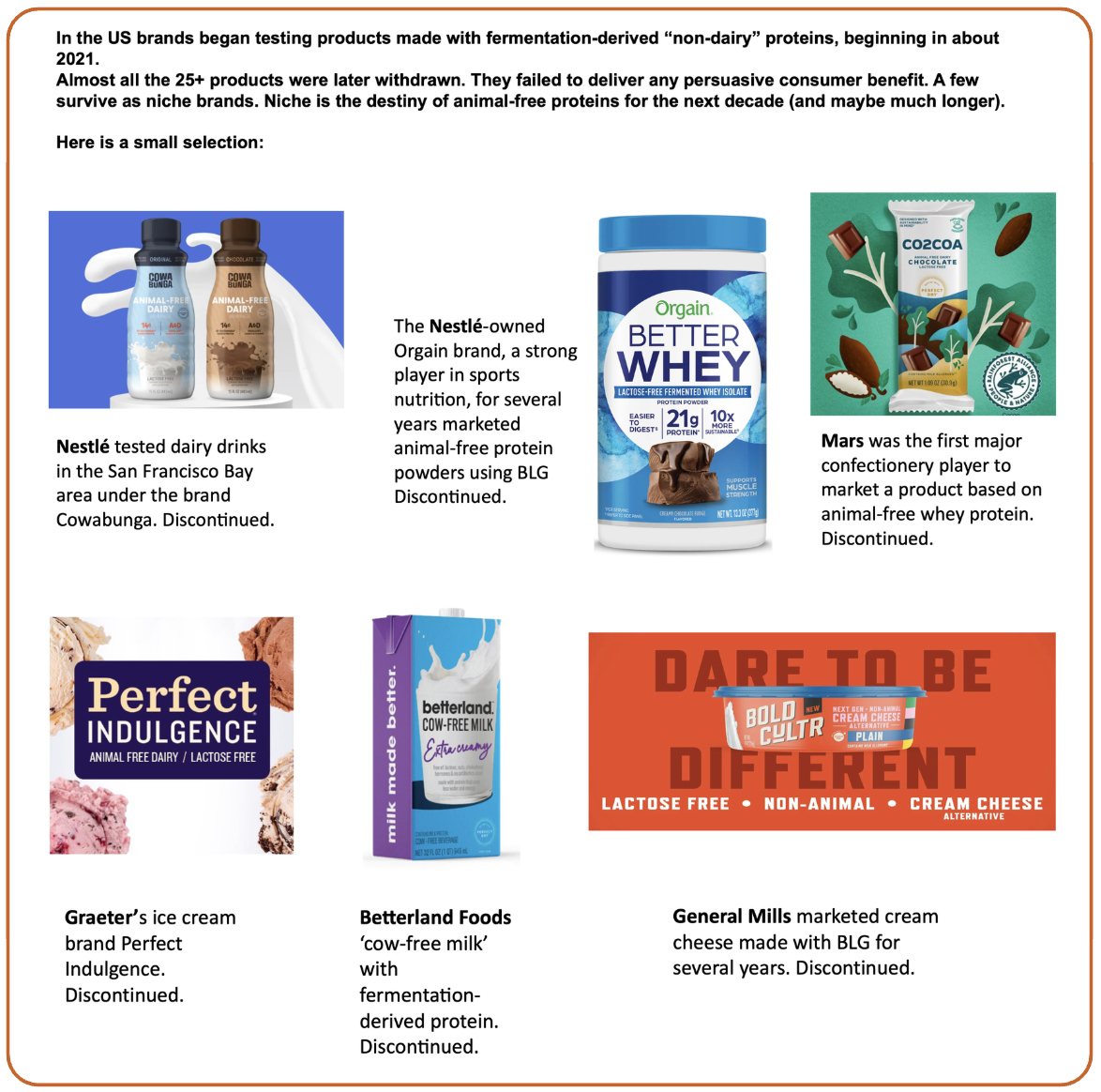
How do we know? From 2021-25 a real-world test of the viability of fermentation-derived dairy proteins took place in the US, where General Mills, Mars, Nestlé and about 15 other companies launched dairy products using BLG.
They have all disappeared from the market, bar one or two which survive as micro-niche brands.
Why? Because, as the list above explains, BLG delivers no special advantage that can persuade humans to switch from a favourite, great-tasting, real, all-natural dairy-food to something that is difficult to understand and sounds like "eating technology". In addition, humans do not knowingly eat technology. If you want to know more about that subject we have a podcast here: https://bit.ly/3NGAJgk
Now you might say that can change if we "educate" the consumer. But the days of "educating" consumers are over. The consumer gets their information from social media and increasingly also from AI. Among consumers 18-34 more than half use social media and/or AI as their primary source information about nutrition and health.
Your company and your marketing are powerless against influencers and AI. If you think otherwise let me know, because I have a fermentation-based bridge to sell you.
BLG makers should all study Quorn. It is the case study par excellence of how to create and market a new type of protein. Quorn created mycoprotein-derived protein and began to commercialise it back in 1989. They did everything right - taste, texture, convenience, familiarity, great marketing. And yet, 35 years later, Quorn is still a niche business. And it is one that has lost money every year for the last three years. Its owner, Monde Nissin, has written off $680 million of the investment it made in Quorn. It's unlikely that any of the executives who run BLG businesses has read the Quorn case study and extracted the lessons from it. As a result, a few years from now many owners of BLG production plants will also be writing off big chunks of their investments.
The technological competence of the people who make BLG proteins is impressive. Their ignorance of human motivations and food culture is their Achilles heel.


